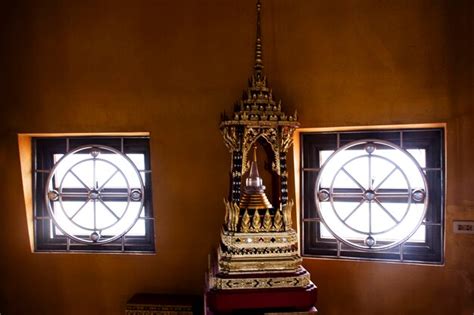
Una colección de reliquias de Buda y de otros maestros budistas ha recorrido durante años muchos lugares del mundo bajo el nombre de ‘Maitreya Heart Shrine Relic Tour‘. Entre los objetos expuestos están las famosas ‘sharira’ (reliquias) o ‘ringsel‘. Se trata de partículas redondeadas de diferentes colores, una especie de piedrecitas, duras y de naturaleza indeterminada. Una vez recogidas, se conservan en relicarios o en ‘stupa’, o dentro de estatuas que después se convierten en objeto de veneración.
Se cree que son la materialización de las cualidades espirituales de compasión y sabiduría del maestro al que pertenecieron. La bendición recibida con estas reliquias, apoyándolas sobre la cabeza, libera al creyente del ‘karma‘ negativo. Estas reliquias reciben veneración en todas las escuelas o corrientes budistas. Según la tradición, las ‘sharira‘ de Buda fueron divididas en ocho partes y distribuidas en otros tantos ‘stupa’.
Buda murió en Kushinagar, en el norte de la India, en el siglo VI a.C. y, según la tradición india, su cuerpo fue incinerado. El monje que hizo la distribución sustrajo un diente y lo escondió en su turbante pero Sakka, el rey de los dioses, se introdujo furtivamente en el turbante del monje para, a su vez, robar el diente y lo transportó en el reino celestial. Por lo tanto en la Tierra sólo quedó uno, el que fue regalado al rey Brahmadatte de Dantapuri, en el estado de Orissa.
Cuando en el siglo XVI las primeras potencias coloniales llegaron a la isla invadieron inicialmente la costa. Kandy, donde estaba custodiado el diente, se encuentra en el interior, en una zona montañosa y no de fácil acceso. Por lo tanto durante un cierto tiempo el diente permaneció tranquilo. Cuando los ingleses llegaron hasta allí destruyendo las defensas de Kandy, lo primero que hicieron fue poner bajo su protección la reliquia. En 1818 comenzó la guerra de independencia durante la cual el diente permaneció durante algún tiempo bajo el control británico. El diente se conserva en un cofre que se abre al público sólo una vez cada cinco años. Cada año, durante el plenilunio entre julio y agosto, se celebra en Kandy la conocida fiesta ‘Esala Perahera‘, que recuerda la llegada a Sri Lanka de la reliquia y que consiste en una procesión de elefantes ricamente decorados, que ha hecho famosa la isla en el mundo. Uno de los elefantes, el más grande, el ‘Maligawa Tuskra‘, lleva un baldaquino con la copia del cofre que contiene el diente.
Pero, por qué existen otros dientes de Buda en el mundo? Kubilai Khan (el Gran Can de Marco Polo) quería poseer una reliquia de Buda y la pidió a Kandy a través de sus emisarios. Con la llegada del comunismo los chinos no le dieron mucha importancia. En los años cincuenta, Birmania pidió prestado a China el diente para una exposición. Los chinos se lo enviaron sin ninguna intención de que le fuera devuelto, pero más tarde, cuando comprendieron la importancia de la reliquia lo reclamaron. Los birmanos, privados de la reliquia, consiguieron una copia (un falso de un falso), para poderlo venerar. Una vez al año el diente (es decir, la copia) se saca de su sagrario en Paungde, se pone en la grupa de un elefante y se lleva en procesión. Esto está considerado como una bendición para todos los presentes.
Actualmente en la India, que es la cuna del budismo -aunque actualmente entre las religiones dominantes de este país el budismo no es una de ellas- es posible hacer el ‘Tour de Buda’ con un tren especial, el Mahaparanirvana Express (Maha = grande), que recorre todos los lugares sagrados ligados a la vida de Siddharta. Saliendo de Delhi podremos visitar Lumbini, donde nació; Bodh Gaya, donde tuvo la iluminación; Sarnath y Rajgir, donde Buda pronunció sus más importante discursos públicos; y Kushinagar, donde murió.
El Stupa de Sanchi es un complejo budista, famoso por su Gran Stupa, en la cima de una colina en la ciudad de Sanchi, en el distrito de Raisen del estado de Madhya Pradesh, India. Se encuentra a 46 kilómetros (29 millas) al noreste de Bhopal, la capital de Madhya Pradesh. El Gran Stupa de Sanchi es una de las estructuras de piedra más antiguas de India y un monumento importante de la arquitectura india. Fue encargado originalmente por el emperador Ashoka en el siglo III a.C. Su núcleo era una simple estructura hemisférica de ladrillo construida sobre las reliquias del Buda. Estaba coronado por el chhatri, una estructura similar a un parasol que simboliza un alto rango, que tenía la intención de honrar y proteger las reliquias. El trabajo de construcción original de este stupa fue supervisado por Ashoka, cuyo esposa Devi era la hija de un comerciante de la cercana Vidisha. Sanchi también fue su lugar de nacimiento, así como el escenario de su boda con Ashoka. En el siglo I a.C., se añadieron cuatro toranas elaboradamente talladas y una barandilla que rodea toda la estructura.
El Stupa de Sanchi construido durante el período Maurya estaba hecho de ladrillos. Borobudur, también transcrito como Barabudur, es un templo budista Mahayana del siglo IX en la región de Magelang, no lejos de la ciudad de Muntilan, en Java Central, Indonesia. Es el templo budista más grande del mundo. El templo consta de nueve plataformas apiladas, seis cuadradas y tres circulares, coronadas por una cúpula central. Está decorado con 2,672 paneles de relieves y originalmente 504 estatuas de Buda.
Sokushinbutsu (即身仏) are a kind of Buddhist mummy. The term refers to the practice of Buddhist monks observing asceticism to the point of death and entering mummification while alive. The Buddha Tooth Relic Temple and Museum is a Buddhist temple and museum complex located in the Chinatown district of Singapore. The Global Vipassana Pagoda is a Meditation Dome Hall with a capacity to seat around 8,000 Vipassana meditators near Gorai, North-west of Mumbai, India. The Pagoda was inaugurated by Pratibha Patil, then President of India on 8 February 2009. It is built on donated land on a peninsula between Gorai creek and the Arabian Sea. The pagoda is to serve as a monument of peace and harmony.
Ramagrama stupa is a stupa located in Ramgram Municipality, in the Nawalparasi District of Nepal. Śarīra is a generic term referring to Buddhist relics, although in common usage it usually refers to pearl or crystal-like bead-shaped objects that are purportedly found among the cremated ashes of Buddhist spiritual masters. Relics of the Buddha after cremation are termed dhātu in the Mahaparinibbana Sutta. Śarīra are held to emanate or incite ‘blessings’ and ‘grace’ within the mindstream and experience of those connected to them. Asuka-dera (飛鳥寺), also known as Hōkō-ji (法興寺), is a Buddhist temple in Asuka, Nara. The Buddha Dhatu Jadi is located close to Balaghata town, in Bandarban City, in Bangladesh. Dhatu are the material remains of a holy person, and in this temple the relics belong to Buddha. The footprint of the Buddha is an imprint of Gautama Buddha’s foot or both feet. There are two forms: natural, as found in stone or rock, and those made artificially.
Buddhist mummies, also called flesh body bodhisattvas, full body sariras, or living buddhas (Sokushinbutsu) refer to the bodies of Buddhist monks and nuns that remain incorrupt, without any traces of deliberate mummification by another party. Many were destroyed or lost to history. Bulguksa is located on the slopes of Mount Toham. It is a head temple of the Jogye Order of Korean Buddhism and encompasses six National treasures of South Korea, including the Dabotap and Seokgatap stone pagodas, Cheongun-gyo, and two gilt-bronze statues of Buddha. The temple is classified as Historic and Scenic Site No. 1 by the South Korean government.
Cetiya, «reminders» or «memorials», are objects and places used by Theravada Buddhists to remember Gautama Buddha. According to Damrong Rajanubhab, four kinds are distinguished in the Pāli Canon: «Relic [Dhatu], Memorial [Paribhoga], Teaching [Dhamma], and votive [Udesaka].» Griswold, in contrast, states that three are traditional and the fourth, the Buddha Dhamma, was added later to remind monks that the true memory of Gautama Buddha can be found in his teachings. Dāṭhavaṃsa is a Pali chronicle attributed to Dhammakitti Thero. It is sometimes titled in English as «The History of the Tooth Relic» and contains histories and popular traditions associated with the Relic of the tooth of the Buddha. Famen Temple is a Buddhist temple located in Famen town, Fufeng County, 120 kilometers west of Xi’an, Shaanxi, China. Giác Lâm Temple is a historic Buddhist temple in Ho Chi Minh City, the largest city in Vietnam. Built in 1744, it is one of the oldest temples in the city. It was officially listed as a historical site by the Vietnamese Department of Culture on November 16, 1988 under Decision 1288 VH/QD. The temple is located at 118 Lạc Long Quân, in the 23rd ward of Tân Bình district, in the Phú Thọ Hòa region of the city. Hōryū-ji is a Buddhist temple that was once one of the powerful Seven Great Temples, in Ikaruga, Nara Prefecture, Japan. Kaylartha Pagoda is a Buddhist Pagoda that sits atop the summit of Mount Kaylartha in Mon State, Myanmar. Kyaiktiyo Pagoda is a well-known Buddhist pilgrimage site in Mon State, Burma. Mahindarama Buddhist Temple is a Sri Lankan temple situated in Jalan Kampar of George Town of Penang in Malaysia. It is the sole and the oldest Malaysian Sri Lankan temple in the state which is also one of the few temples in Malaysia where the Buddha’s relics are stored. Kakuōzan Nittai-ji is a Buddhist temple located in the city of Nagoya, Aichi prefecture, Japan. It was built in 1904 in order to keep the ashes of Buddha, given to Japan by the Kingdom of Thailand. Pha That Luang is a gold-covered large Buddhist stupa in the centre of the city of Vientiane, Laos. Since its initial establishment, suggested to be in the 3rd century AD, the stupa has undergone several reconstructions as recently as the 1930s due to foreign invasions of the area. Qixia Temple is a Buddhist temple located on Qixia Mountain in the suburban Qixia District of Nanjing, Jiangsu, 22 kilometres (14 mi) northeast of downtown Nanjing. It is one of Nanjing’s most important Buddhist monasteries. Sariputra and Mahamoggallana were the two chief disciples of Gautama Buddha, and died within two weeks of one another, after which they were cremated and their relics kept. Lama Sangha Tenzin was a Buddhist monk. He is thought to have died in the 1500s. His remains are preserved as a mummy, which was discovered in 1975 in Gue, a small town in the Indian state of Himachal Pradesh. Tenzin’s tomb was established in the village near the Line of Actual Control (LOC) in the Spiti Valley. His body is the only mummy of a Buddhist monk in India that was naturally mummified (self-mummification). However, the mummy was buried in an earthquake, leading the body to be rediscovered by ITBP personnel in 2004 when they were constructing roads in the area. Shitennō-ji is a Buddhist temple in Ōsaka, Japan. It is also known as Arahaka-ji, Nanba-ji, or Mitsu-ji. The temple is sometimes regarded as the first Buddhist and oldest officially-administered temple in Japan, although the temple complex and buildings have been rebuilt over the centuries, with the last reconstruction taking place in 1963. The Sule Pagoda is a Burmese stupa located in the heart of downtown Yangon, occupying the centre of the city and an important space in contemporary Burmese politics, ideology and geography. According to legend, it was built before the Shwedagon Pagoda during the time of the Buddha, making it more than 2,600 years old. The Temple of the Sacred Tooth Relic or Sri Dalada Maligawa, is a Buddhist temple in Kandy, Sri Lanka. It is located in the royal palace complex of the former Kingdom of Kandy, which houses the relic of the tooth of the Buddha. Since ancient times, the relic has played an important role in local politics porque it is believed that whoever holds the relic holds the governance of the country. The relic was historically held by Sinhalese kings. Tongdosa is a head temple of the Jogye Order of Korean Buddhism and in the southern part of Mt. Uppātasanti Pagoda is a prominent landmark in Naypyidaw, the capital of Myanmar. The pagoda houses a Buddha tooth relic from China. Wat Chetawan is a Thai temple in Petaling District, Selangor, Malaysia. The temple is situated at Jalan Pantai, off Jalan Gasing in Petaling Jaya. It was built in 1957 and officiated by the late King Bhumibol Adulyadej, the King of Thailand at the time. Wat Phra That Doi Suthep is a Theravada Buddhist temple (wat) in Chiang Mai Province, Thailand. The temple is often referred to as «Doi Suthep» although this is actually the name of the mountain where it’s located. It is a sacred site to many Thai people. The temple is 15 kilometres (9.3 mi) from the city of Chiang Mai and situated at an elevation of 1,073 meters.